

Most small businesses don’t lose contracts because they’re unqualified.
They lose because they get overwhelmed by massive solicitations, confusing requirements, and proposal instructions that look like they were written by a committee—because they were.
Here’s a smarter way to break down government RFPs—and the tool I use to speed up the process.
Exclusive Discount on DeepRFP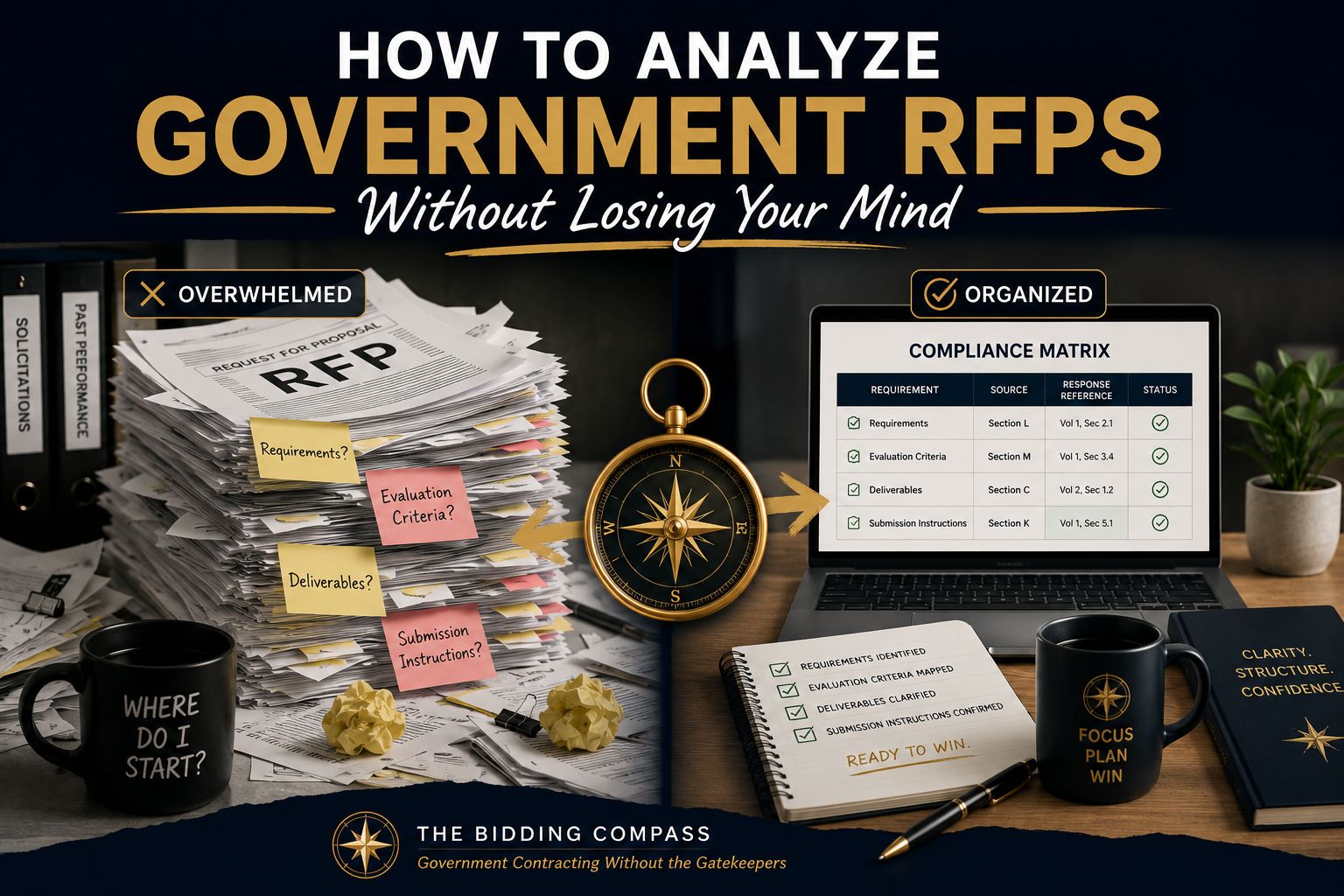
Why Most Small Businesses Never Submit Their First Proposal
You find the perfect opportunity on SAM.gov.
The NAICS code fits.
The set-aside fits.
You’ve been doing the work for years.
Then you download the solicitation.
And suddenly you’re staring at 147 pages of instructions, attachments, evaluation factors, and requirements.
Most small businesses don’t quit because they can’t do the work.
They quit because they don’t know where to start.
This is the bottleneck nobody talks about. Not registration. Not certifications. Not even finding opportunities. It’s the moment the document opens and the overwhelm sets in.
Here’s what builds that wall:
- 100+ page RFPs written to be legally complete, not easy to read
- Requirement overload — mandatory items scattered across sections, attachments, and amendments
- Compliance confusion — what’s required vs. optional isn’t always clear
- Proposal fatigue — building a compliant response from scratch, alone, while running a real business
Every one of these is solvable. This guide shows you how.
The Four Things You Must Understand Before Writing a Single Word
Experienced proposal managers don’t read an RFP the same way you’d read a book. They know what they’re looking for — and they go straight to it. Here are the four areas that govern every government solicitation.
Scope of Work (PWS / SOW / SOO)
Understand exactly what the government is asking you to perform. Define the work, deliverables, performance standards, locations, and contract objectives before worrying about proposal writing.
Section L – Instructions
Section L explains how your proposal must be organized and submitted, including required documents, page limits, formatting, deadlines, and certifications. A technically excellent proposal can still be rejected if these instructions aren't followed.
Section M – Evaluation
Section M tells you how evaluators will score your proposal. It identifies the evaluation factors, their relative importance, and what the government values most. Write your proposal to match these criteria — not just the statement of work.
Requirements & Compliance
Track every "shall," "must," "will," required form, attachment, and amendment throughout the solicitation. Missing even one mandatory requirement can result in your proposal being rejected before it is evaluated.
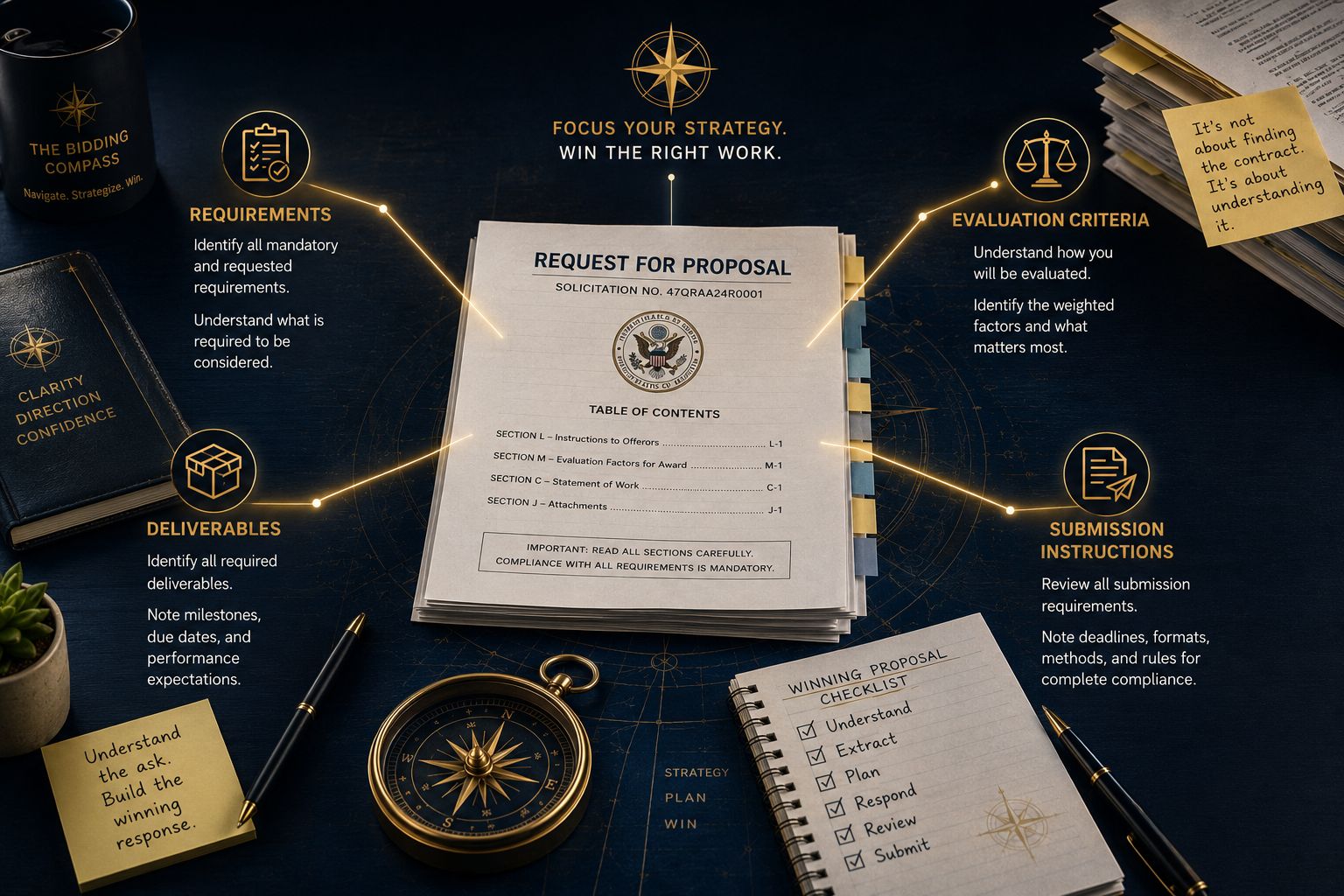
Understand these four areas first. Then you write.
Why Experienced Contractors Read Sections L & M First
Here’s something most beginners don’t know: experienced proposal managers rarely start reading an RFP from page one.
They go straight to two sections first — and everything else in the solicitation supports what’s written there.
Section L — Instructions to Offerors
- ›What must be submitted
- ›Required documents and attachments
- ›Proposal structure and organization
- ›Page limits per section
- ›Submission format and deadline
Section M — Evaluation Factors
- ›How proposals are scored
- ›Evaluation factors and subfactors
- ›Relative importance of each factor
- ›What evaluators are looking for
Remember
Section L tells you what to submit.
Section M tells you how you’ll be evaluated.
Everything else in the solicitation supports those two sections.
The Traditional RFP Review Process (And Why It Breaks Down)
Let’s be honest about what the manual process actually looks like for most small businesses doing this for the first time:
Without a Structured Process
- 01Read the entire solicitation cover to cover
- 02Go back through and highlight requirements manually
- 03Build a spreadsheet to track each requirement
- 04Create a compliance matrix matching requirements to response sections
- 05Organize and outline response sections before writing a single word
Estimated time: 10–30+ hours — before writing begins
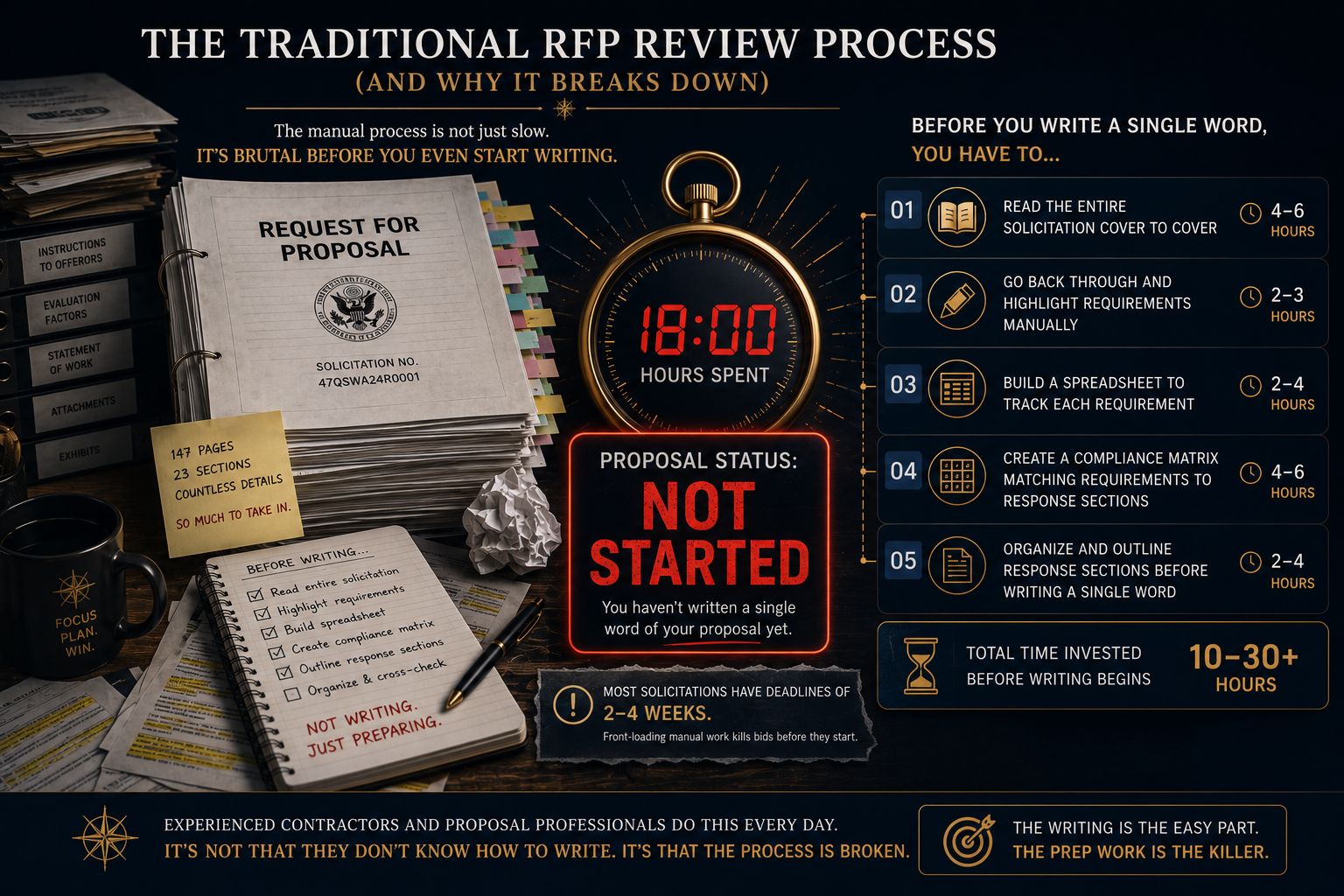
This process works. Experienced contractors and proposal professionals do it every day.
But for a solo operator or small team doing this for the first few times? That’s easily a week of work before you’ve written a single sentence of your actual proposal.
And because most solicitations have deadlines of 2–4 weeks, that front-loading of manual work becomes the bottleneck that kills bids before they start.
🧭
Most beginners think proposal writing is the hard part.
It isn’t.
Understanding the RFP is the hard part.
The writing comes after.
🎉 Exclusive Discount for Bidding Compass Readers
Save 10% with code:
BIDDING-COMPASS-AETL10% Off DeepRFP
Enter this code at checkout to apply your discount. This code is how your referral through The Bidding Compass is tracked — don’t skip it.
Want to Cut Through the Organizational Work?
DeepRFP extracts requirements, builds your compliance matrix, and generates a structured draft based on your RFP—so you’re not starting from scratch.
Free 7-day trial—no credit card needed. Use code BIDDING-COMPASS-AETL at checkout for 10% off.
Try DeepRFP (10% Off)Affiliate link — supports this free site at no extra cost to you.
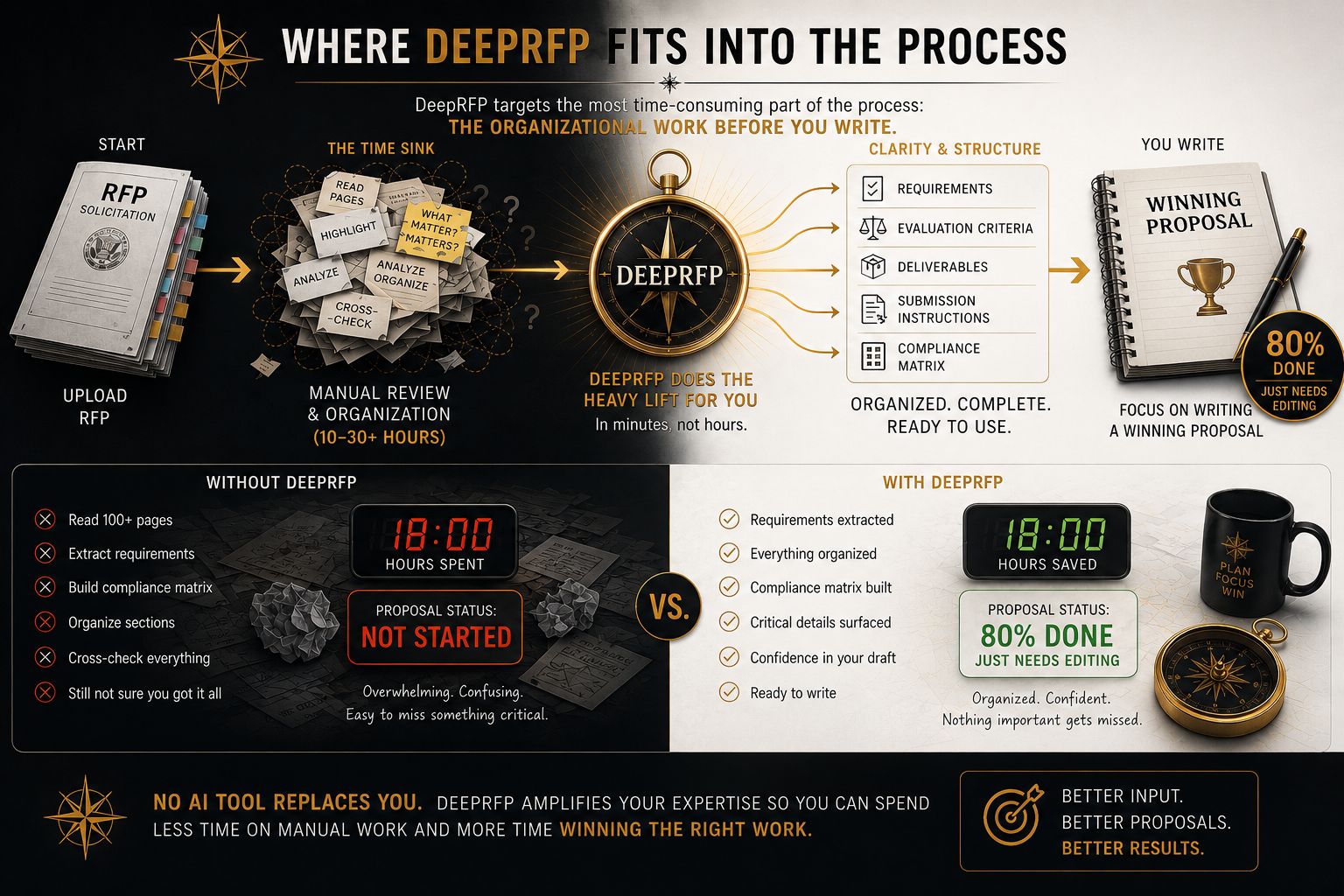
Where DeepRFP Fits Into the Process
Once you understand what to look for, the challenge becomes finding it — across a solicitation that may exceed 200 pages. Instead of manually searching for every requirement, evaluation factor, amendment, and submission instruction, DeepRFP automatically extracts that information into an organized checklist, helping you review solicitations faster while reducing the risk of overlooking critical details.
No software wins contracts for you. No AI tool replaces your expertise, your past performance, or your understanding of what the government actually needs.
What DeepRFP does is target the most time-consuming part of the process: the organizational work before you write.
Specifically, it helps with:
Faster Requirement Extraction
Instead of reading 100+ pages manually, DeepRFP pulls and organizes requirements automatically from the uploaded RFP document.
Better Organization
Requirements are structured and categorized so you can see what needs to be addressed in each section — without building the matrix from scratch.
Less Manual Work
The spreadsheet, the compliance matrix, the section outline — DeepRFP handles the scaffolding so you're not rebuilding it from zero on every bid.
Faster Proposal Preparation
You start writing from a structured draft — not a blank document. For small businesses with limited time, this changes what's realistic to submit.
Important
DeepRFP does not guarantee contract awards. It accelerates the organizational phase of proposal development. Winning contracts still requires competitive pricing, relevant past performance, and a technically sound proposal that speaks to what the evaluators are looking for.
Watch DeepRFP in Action: From RFP Upload to Proposal Draft
The clip below shows the core workflow: upload a government solicitation, let DeepRFP automatically extract Section L and Section M requirements, and start writing from a structured draft instead of a blank page. What used to take 10–30 hours of manual setup takes minutes.
Here’s a look at the key features inside a real proposal workflow:
Requirement Extraction
Upload your RFP document and DeepRFP automatically identifies and lists every requirement — the "shall" and "must" statements — so nothing gets missed.
Compliance Analysis
The compliance matrix maps each requirement to the relevant section of your proposal, so you can see at a glance whether your response covers everything the government is asking for.
Proposal Drafting Support
Based on the requirements and your inputs, DeepRFP generates a structured draft for each section — giving you a starting point you can refine rather than a blank page to fill.
Workspace Organization
All your active opportunities, documents, and drafts are organized in one workspace — so you're not hunting through folders and email threads when a deadline is approaching.
My Honest Assessment
The work was never the scary part.
The paperwork was.
DeepRFP won’t write a winning proposal for you.
But it can turn a giant stack of government paperwork into something that actually feels manageable.
That’s why I highly recommend it.
“The hardest part of a proposal isn’t writing it. It’s getting organized enough to know what to write. That’s what this solves.”
— Tiffany, The Bidding Compass
Who Should Use DeepRFP?
I want to give you a straight answer here, because not everyone should use this right now — and I’d rather you know that upfront than waste money on a tool you’re not ready for.
✅ Good Fit
- +Businesses actively reviewing real opportunities on SAM.gov
- +Small teams preparing to submit a proposal
- +Contractors dealing with large, complex RFPs (50+ pages)
- +Businesses looking to reduce hours spent per bid
⏸ Probably Not Necessary Yet
- –People still learning the basics of government contracting
- –Businesses not yet registered in SAM.gov
- –Visitors still researching whether government contracting is right for them
- –Companies not planning to submit bids in the near term
If you’re in the “not yet” column, keep going through the guides. You’ll get there. When you do, come back to this page.
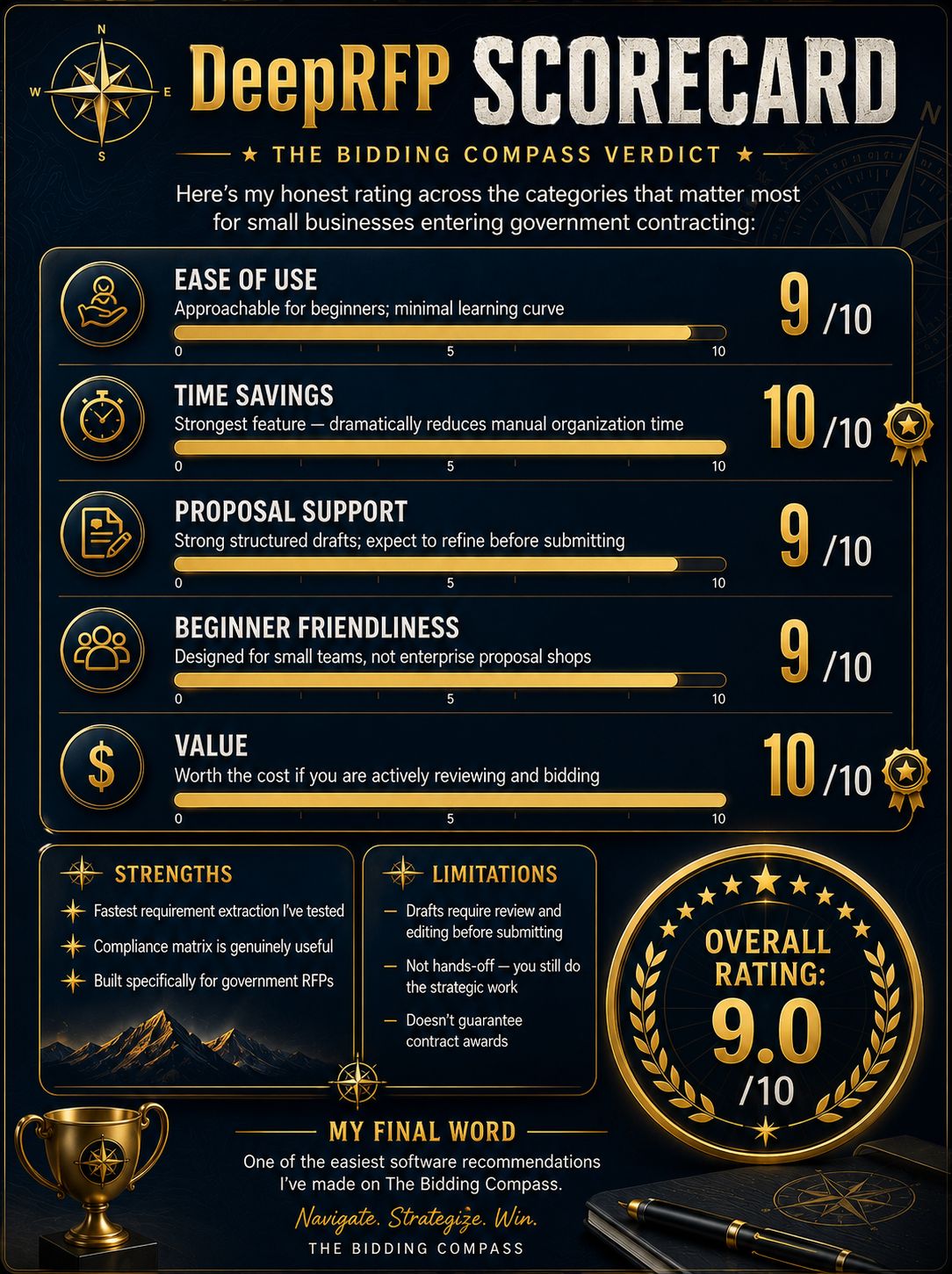
DeepRFP Scorecard
Here’s my honest rating across the categories that matter most for small businesses entering government contracting:
Why I Recommend DeepRFP
I’ve tested several tools in this space. Here’s why DeepRFP is the one I point beginners toward:
- ✓
Built specifically for government RFPs
Not a general-purpose AI writing tool adapted after the fact. It was designed from the ground up for federal solicitations.
- ✓
Fastest requirement extraction I've tested
Upload your solicitation and it pulls every "shall" and "must" automatically — in minutes, not hours.
- ✓
Compliance matrix included
It doesn't just list requirements. It maps them to your response sections so nothing falls through the cracks.
- ✓
Produces a usable first draft
Not a polished final product, but a real starting point — organized, structured, and ready to refine.
- ✓
Affordable for small businesses
At $75–125/month with a free 7-day trial, it's a fraction of what a proposal consultant charges for a single bid.
Common Questions About This Topic
Looking for more government contracting questions and answers?
Visit our complete FAQ →Most people think winning comes down to writing better proposals.
It doesn’t start there. It starts with how well—and how quickly—you break down the RFP. Get that part right, and everything else gets easier.
🎉 Exclusive Discount for Bidding Compass Readers
Save 10% with code:
BIDDING-COMPASS-AETL10% Off DeepRFP
Enter this code at checkout to apply your discount. This code is how your referral through The Bidding Compass is tracked — don’t skip it.
Before you go: Don’t forget to use code BIDDING-COMPASS-AETL for 10% off your DeepRFP subscription.
Ready to Simplify Your Next RFP?
If you’re actively reviewing government opportunities and want help organizing requirements, identifying compliance items, and accelerating proposal preparation, DeepRFP may be worth exploring.
Try DeepRFP free for 7 days — no credit card needed.
Use code BIDDING-COMPASS-AETL at checkout for 10% off.
Disclosure: This is an affiliate link. If you use it, it helps support this free site at no extra cost to you. We only recommend tools we’ve personally used.
The Bidding Compass — Pointing Your Business in the Right Direction.
Your Next Step
Almost There. One Guide Left.
You've learned how to read an RFP and use tools to accelerate your proposal. The final guide covers what happens after you hit submit — and what to do while you wait.
Go to Guide 7: After You Submit →